Laissez un message
Si nos produits vous intéressent et que vous souhaitez en savoir plus, veuillez laisser un message ici, nous vous répondrons dans les plus brefs délais.

Here is a SEO-optimized blog post tailored for B2B buyer audiences (such as food distributors, catering suppliers, wholesalers, and private-label brands).
It is designed to highlight product advantages, target applications, and packaging variations to capture high-intent search traffic.
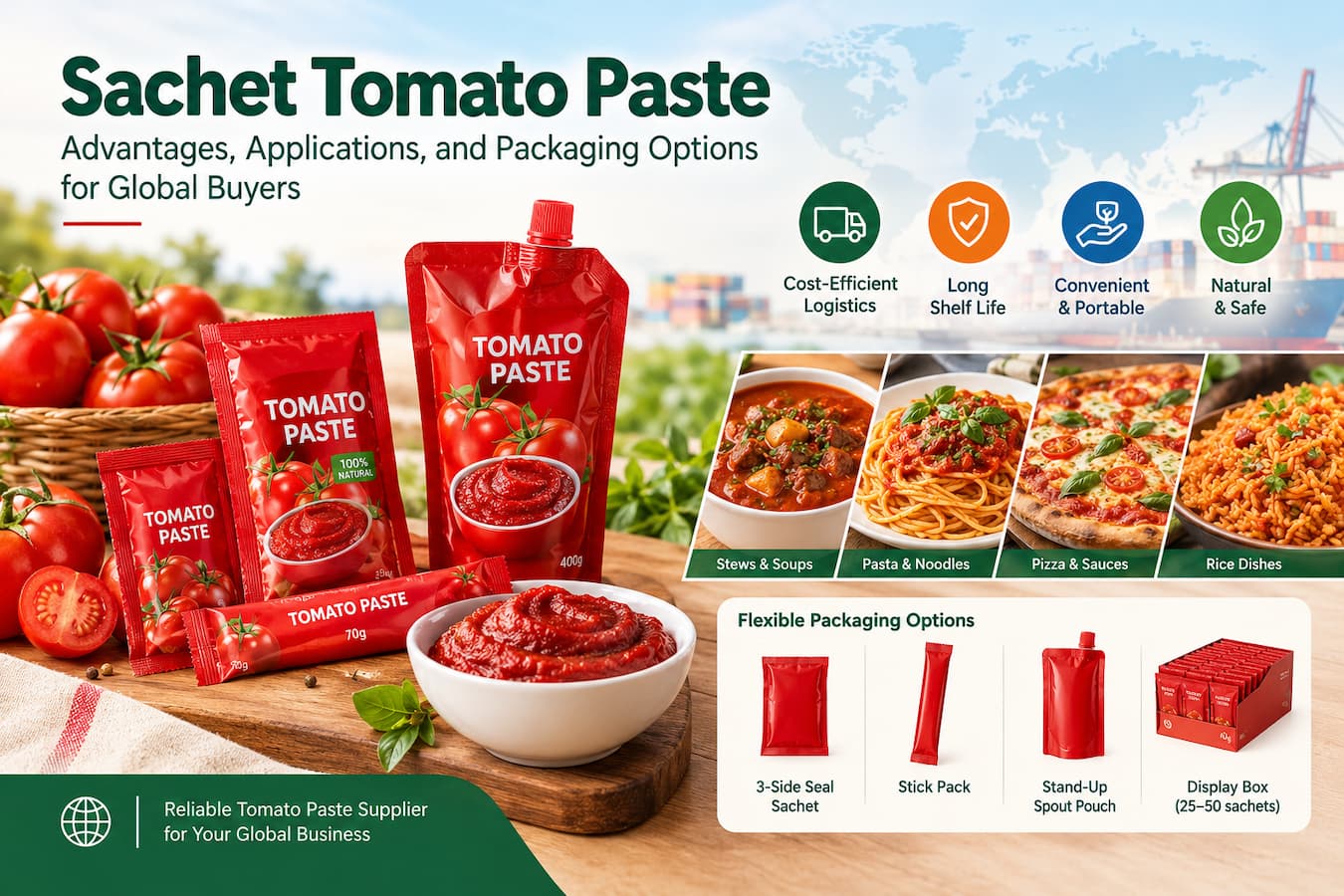
Sachet Tomato Paste: Advantages, Applications, and Packaging Options for Global Buyers
When sourcing tomato products on a commercial scale, convenient packaging often makes all the difference in cost efficiency, shelf life, and end-user adoption. While traditional tin cans remain a staple, sachet tomato paste has rapidly grown into one of the most in-demand formats worldwide—especially across West Africa, the Middle East, and South America.
Whether you are a food importer, wholesale distributor, or private-label brand manager, understanding the key benefits, culinary applications, and packaging specifications of flexible sachet tomato paste will help you make smarter purchasing decisions.
Compared to rigid metal cans or glass jars, flexible pouch packaging offers distinct operational and commercial benefits:
Superior Portability & Single-Serve Convenience: Sachets provide pre-measured servings (typically 50g to 100g), eliminating the need for leftover storage and reducing food waste in households and quick-service kitchens.
Cost-Efficient Freight & Logistics: Flexible pouches weigh significantly less than metal tins and occupy less volume when packed in bulk master cartons. This significantly lowers shipping fees and maximizes container space during sea freight.
Easy Opening & Safe Handling: No can opener required. Sachets feature tear notches that allow consumers to open them easily and safely without sharp edges.
Extended Shelf Life & Protection: High-barrier multi-layer laminate films (aluminum foil/PET/PE) protect the tomato paste from moisture, light, oxidation, and bacteria—ensuring a 18-to-24-month shelf life without heavy preservatives.
Better Margins for Retailers: Due to lower production, material, and transport costs, sachet-packed paste can be retailed at an attractive entry-level price point while maintaining healthy profit margins.
Tomato paste in sachets typically comes in two concentration grades: 28-30% Brix (Cold Break/Hot Break) and 36-38% Brix. Its versatility makes it suitable for diverse market segments:
| Target Market / Segment | Primary Application & Usage |
| Household Retail & Supermarkets | Daily home cooking for soups, stews, rice dishes (e.g., Jollof rice), and pasta sauces. |
| Food Service & Quick-Service Restaurants (QSR) | Portion-controlled ingredients for commercial kitchens, pizza bases, marinades, and dipping sauces. |
| Emergency Relief & Military Rations | High-energy, shelf-stable tomato concentrate included in humanitarian food parcels and field rations. |
| Food Manufacturing & Re-Processing | Small-batch production of prepared meals, canned fish sauce bases, and snack flavorings. |
Choosing the right packaging format depends on your target market's purchasing habits and display preferences:
3-Side Seal / 4-Side Seal Sachets: The most popular single-use format. Compact, flat, and easy to pack into display boxes.
Stick Packs / Pillow Pouches: Slimmer profile, ideal for low-grammage samples or budget-friendly mass retail.
Stand-Up Spout Pouches (100g–500g): Reclosable pouches featuring a plastic screw cap—combining sachet affordability with multi-use convenience.
Small Sachets: 50g, 70g (most popular for West Africa), 100g
Spout Pouches: 150g, 210g, 400g, 500g
Inner Display Packaging: 25–50 sachets per printed display box (or shrink-wrapped strips/chains).
Outer Packaging: 200–400 sachets per strong corrugated export carton (5-ply).
When working with OEM/ODM tomato paste manufacturers, pay attention to the following parameters to ensure product consistency:
Brix Content & Viscosity: Confirm whether your market prefers 28-30% Brix or higher density 36-38% Brix.
Bostwick Value & Color (A/B Ratio): High-quality paste should have a bright red color (A/B ratio $\ge 2.1$) and controlled flowability suitable for cooked sauces.
Film Laminate Quality: Ensure the flexible film uses high-barrier layers (PET / AL / PE or PET / VMPET / PE) to prevent leakage, pinholes, and premature degradation during tropical transit.
If you are looking to source bulk tomato paste in sachets , contact our team today to get customized specs and a wholesale price quote.


 English
 Français
 Deutsch
 Italiano
 Pусский
 Español
 Português
 Melayu
 Indonesia
 العربية